 Russian
  English
  Spanish
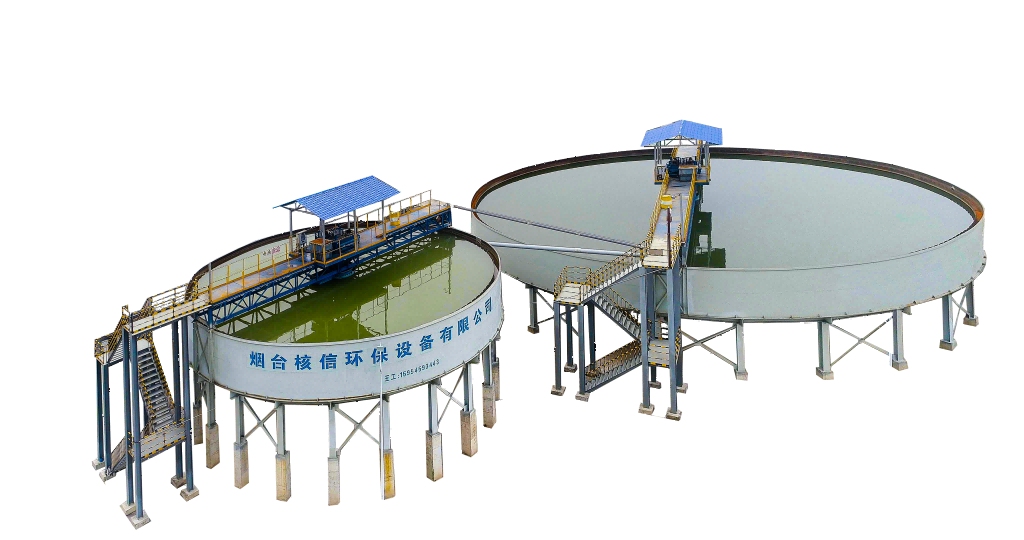
 Choosing a mining thickener manufacturer requires more than comparing tank diameter, power, and price. The selected supplier must show that the equipment can maintain clear overflow, stable underflow concentration, manageable rake load, and safe operation under realistic slurry conditions. Manufacturer evaluation should therefore begin with representative test data and end with a written performance guarantee that defines feed conditions, operating limits, measurement methods, and acceptance criteria.
Why Should Test Data Lead the Evaluation?
Thickener sizing depends on the actual behavior of the project slurry. Laboratory and pilot results provide the basis for selecting settling area, tank depth, feed arrangement, rake mechanism, and underflow withdrawal capacity.
Which Feed Properties Should Be Recorded?
The test program should record feed solids concentration, particle-size distribution, slurry density, mineral composition, clay content, pH, temperature, and process-water chemistry. Samples should represent normal ore, difficult-to-settle ore, peak throughput, and expected future feed changes.
A single average sample may hide the material that controls the final design. The manufacturer should explain how samples were selected and how the proposed thickener responds to adverse conditions.
Which Tests Provide Useful Evidence?
Bench tests should measure settling rate, interface behavior, overflow clarity, flocculant type, dosage, and dilution demand. Compression tests should show how solids concentration changes with bed depth and residence time.
For fine tailings, large projects, or demanding density targets, continuous or pilot testing is preferable. It can reveal solids-inventory, rake-resistance, and underflow-pumping issues that batch tests may miss. A credible supplier should provide procedures, raw results, calculations, and scale-up assumptions rather than only a recommended diameter.
How Should Buyers Assess an Underflow Guarantee?
An underflow guarantee is meaningful only when its measurement basis and operating conditions are defined. Buyers should distinguish among a published performance range, a test-based target, and a contractual guarantee.
How Should Underflow Concentration Be Defined?
The contract should state whether concentration means weight percent solids, volume percent solids, or slurry density. It should also define the sampling point, frequency, test duration, laboratory method, and allowable measurement tolerance.
The official NGZ product page states that underflow concentration can reach 60–70% and describes a deep-compression design with higher concentration efficiency than a conventional thickener. These are published reference values, not universal guarantees, because actual results depend on slurry properties and operating conditions.
Which Conditions Should Be Attached?
A sound guarantee should define feed rate, feed solids concentration, particle-size range, mineralogy, flocculant dosage, dilution water, bed level, underflow withdrawal rate, and steady-state test duration. An overflow suspended-solids limit should also be included, since higher underflow density should not be achieved at the expense of overflow quality.
The agreement should separate normal operation from the maximum design case and assign responsibility for reagents, instrumentation, operator actions, feed variability, and sampling.
What If Performance Falls Short?
The contract should include a correction process covering data review, reagent and dilution adjustment, control tuning, feed-system modification, and repeat testing. Commercial remedies should apply when verified equipment-related deficiencies remain after corrective work. Feed outside the agreed design envelope should be clearly excluded.
Which Equipment Features Support Stable Performance?
Test results establish the process target, while mechanical and control features keep the thickener within the required operating range. Each feature should be linked to a specific process or safety risk.
How Do Feed Conditioning and Flocculant Dosing Help?
Good feed conditioning reduces entrained air, controls feed velocity, and distributes flocculant evenly. According to the NGZ product page, its charging system provides slurry degassing, feed-rate control, flocculant dosing, and multi-point additive feeding to improve mixing and flocculation efficiency.
Buyers should confirm how feed dilution is controlled, how dosage responds to changing tonnage, and which instruments are included in the supplier’s scope.
How Is High Rake Load Managed?
Dense solids beds increase scraper resistance and may overload the drive. The NGZ thickener uses PLC control, overload alarms, automatic rake lifting and lowering, and pressure-relief protection for the motor and hydraulic circuit. Its separate hydraulic lifting cylinder has a published maximum lift of 600 mm.
These functions should be checked during factory testing and commissioning. The supplier should demonstrate alarm logic, stopping conditions, manual recovery, and return to normal operation after an overload event.
Why Consider Yantai Hexin as an NGZ Thickener Supplier?
Supplier reliability should be evaluated through equipment design, technical documentation, manufacturing control, commissioning support, comparable references, and willingness to accept measurable performance terms.
What Does Yantai Hexin Provide?
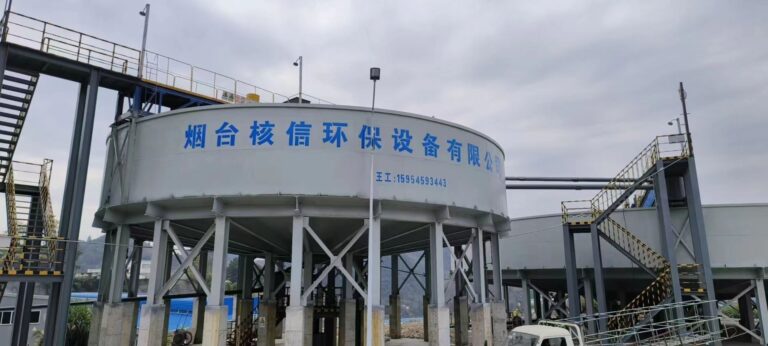
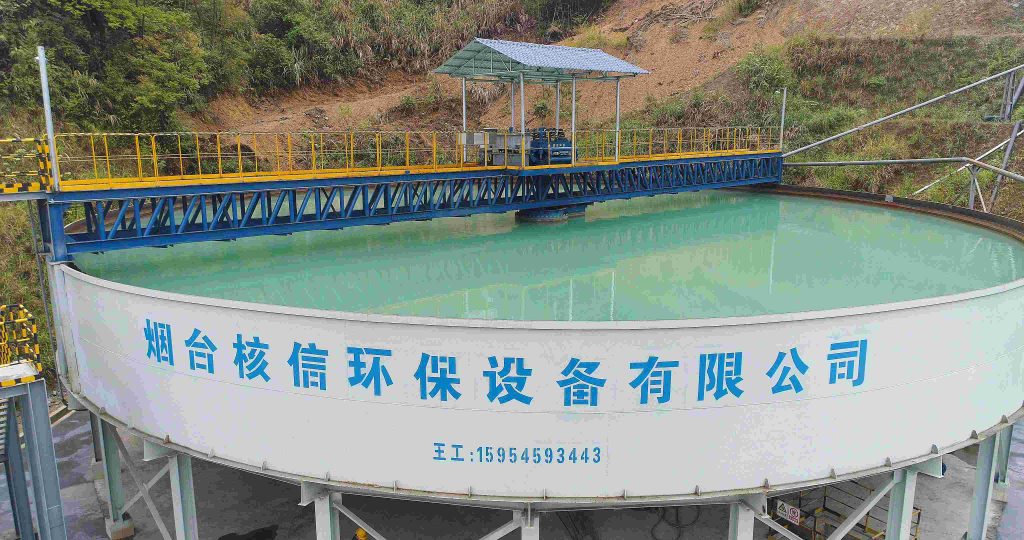
Янтай Хексин Экологическая защита оборудования Ко., ООО supplies the NGZ High Efficiency Thickener for mining, tailings treatment, hydrometallurgy, and environmental engineering. The product combines a central hydraulic drive, automatic rake operation, deep-compression tank geometry, logarithmic-spiral scraper blades, and PLC-based control. Published functions include automatic, manual, and remote modes, oil-temperature regulation, pressure monitoring, emergency stopping, and protected control settings.
These features make Yantai Hexin a practical supplier candidate for projects requiring automated rake protection and high-density thickening. Final selection should still depend on project-specific testing, scope confirmation, manufacturing documents, comparable project evidence, and negotiated guarantees.
Вывод
The strongest proposal is not necessarily the one claiming the highest underflow concentration. It is the one that connects representative slurry testing, transparent scale-up, suitable equipment design, and a measurable acceptance procedure.
Before ordering, buyers should review the test report, sizing calculations, process data sheet, general arrangement drawing, control philosophy, inspection plan, commissioning procedure, warranty terms, spare-parts list, and guarantee schedule. Consistency among these documents improves the likelihood of reliable water recovery, safe rake operation, and predictable lifecycle cost.
Вопросы и ответы
Can One Underflow Density Be Guaranteed for Every Ore?
No. Achievable density varies with particle size, clay content, mineralogy, water chemistry, flocculant response, bed depth, and underflow withdrawal. The guarantee should apply only to the tested feed range and agreed operating conditions.
Are Bench Settling Tests Enough for Final Sizing?
They may be sufficient for preliminary selection, but pilot or continuous testing is advisable for difficult slurry, large equipment, or demanding density targets. More detailed testing reduces scale-up uncertainty.
Which Documents Should Buyers Request Before Ordering?
Buyers should request the test report, sizing basis, technical data sheet, equipment drawings, control description, inspection and test plan, acceptance procedure, warranty conditions, commissioning scope, and recommended spare-parts list.