 Russian
  English
  Spanish
 A dewatering line can look stable for weeks and still be quietly drifting toward trouble. Slurry chemistry shifts, particle size changes with ore blends, and upstream thickening swings the solids concentration. In that environment, a DF Керамический фильтр is not “just another vacuum filter.” It is a specific answer to a specific set of constraints: lower cake moisture, cleaner filtrate, and predictable operation without the constant cloth management that consumes labor and uptime.
Before getting into ceramic vacuum filtration, it helps to align on the separation route and the KPI definitions that actually govern success—cake moisture targets, filtrate clarity under upsets, cycle stability, and water-loop tolerance. For a plant-facing overview, see solid-liquid separation methods, equipment, and industrial use cases.
Why “Ceramic Filter” Needs a Dewatering Context
In industrial search behavior, “ceramic filter” is a messy term. It can refer to water purification elements, high-temperature gas filtration, or process filtration for solids-liquid separation. Buyers in mining, metallurgy, chemicals, and wastewater are typically searching for a ceramic vacuum disc filter concept: a rigid, microporous medium that sustains stable vacuum-driven separation while holding fines and producing a manageable cake.
The practical issue behind the search is rarely curiosity about filtration theory. It is operational pressure. Tailings ponds are full, water reuse is becoming non-negotiable, and a plant is trying to reduce moisture without pushing energy and maintenance costs into an unacceptable range. That is the moment when a ceramic filter begins to “make sense,” not as a trend, but as a change in how separation is controlled.
How DF Ceramic Filters Work in Real Production Cycles
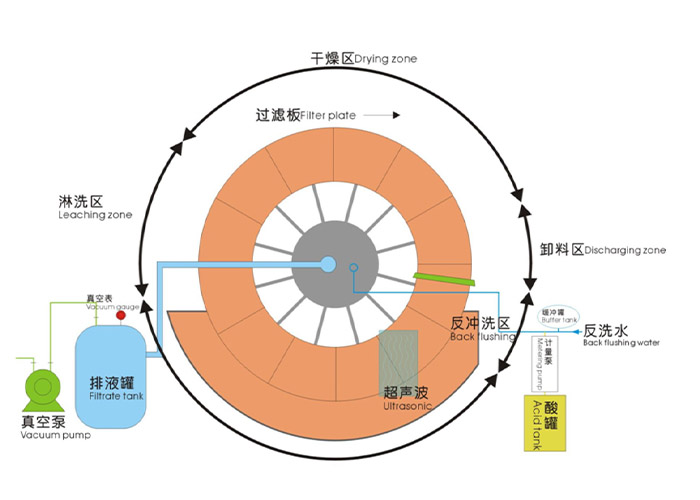
A DF ceramic filter operates as a solid-liquid separation device using vacuum pressure and the capillary characteristics of a ceramic filter plate. Solids are captured on the plate surface under negative pressure, while liquid is pulled through the porous ceramic medium, producing separation driven by pressure differential and the hydrophilic behavior of the ceramic material.
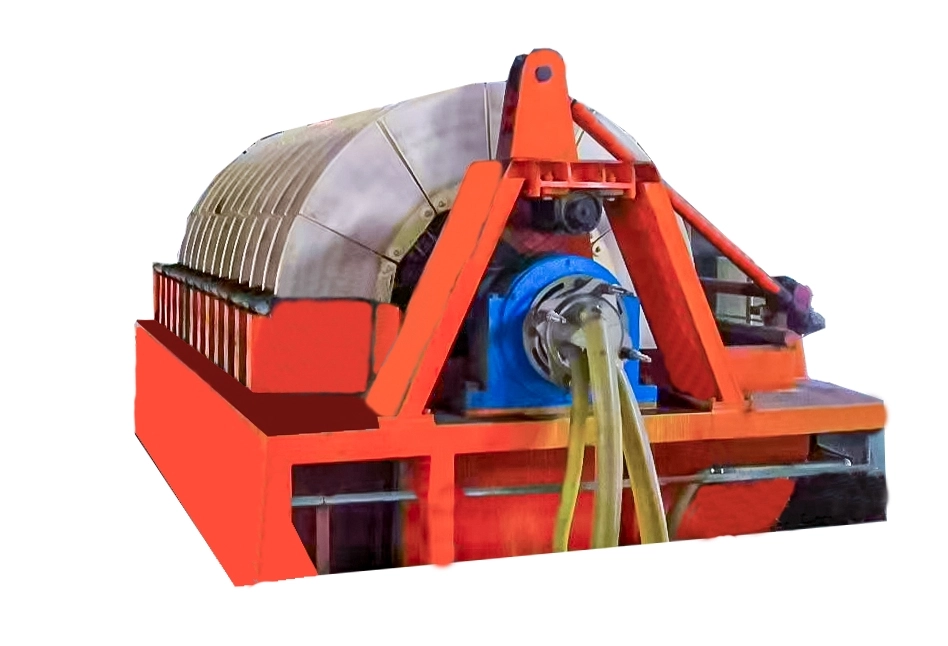
That definition sounds straightforward, yet the real differentiator is the repeatable cycle. The plate enters a slurry trough where a cake forms; the rotor carries the cake into a drying zone where dewatering continues under vacuum; then the plate moves into a discharge zone where vacuum is absent and the cake is removed by a ceramic scraper. After discharge, the plate enters a backwashing zone where industrial water or compressed air is introduced from the inside out to clean internal channels, and periodic ultrasonic cleaning with dilute acid restores plate efficiency when micro-channels begin to foul.
This cycle matters because it shifts the dewatering conversation from “Can the filter separate?” to “Can the filter separate with stable output for months?” In most plants, output loss is not a dramatic failure; it is gradual plugging of the filter medium, gradual vacuum instability, gradual loss of filtrate clarity, and a slow rise in cake moisture that eventually triggers production complaints. A design that assumes cleaning as part of normal operation tends to stay in control longer than a design that treats cleaning as an emergency response.
When DF Ceramic Filters Make Sense
Concentrate dewatering where cake moisture carries a real penalty
In concentrate handling, moisture is not just a number on a lab sheet. It can drive shipping cost, reduce smelter acceptance, create handling problems in cold weather, and turn a material flow into a storage headache. A ceramic filter’s ability to produce a comparatively dry cake is often valuable when downstream logistics are sensitive to free water, and when the plant wants a stable moisture band rather than a best-case snapshot.
In these settings, decision-makers should think in operating days, not vendor demos. If a filter holds moisture within a tighter range while maintaining filtrate quality, it reduces the “hidden costs” that show up as overtime, rework, and processing delays. The financial effect can easily exceed the equipment delta, especially when concentrate value is high and shipment terms are strict.
Tailings dewatering for dry stacking and water recovery
Tailings is where the value proposition becomes more obvious. The DF ceramic filter is described as being widely used in mining applications, including concentrate and tailing discharge, with benefits that include low solid content in the filtrate and reduced moisture in the filter cake. In many operations, this translates to improved water reuse and reduced reliance on tailings storage structures, which are increasingly scrutinized for environmental and safety risk.
A realistic site pattern looks like this: a concentrator has a thickener upstream, but the underflow still carries too much water to support stable stacking, and the pond return line is not keeping up with fresh water demand. If the plant can move tailings toward a drier, more stable cake, the handling method changes, and water becomes an internal resource rather than a persistent shortage. The operational “win” is not a single metric; it is fewer constraints on production during water-limited seasons and fewer emergency responses when a pond reaches its limits.
Sewage sludge and industrial waste streams that need controllable separation
The DF ceramic filter is also positioned for environmental protection use cases such as sewage sludge and waste acid treatment. These streams are rarely uniform. They can include fine solids, variable chemistry, and a higher risk of fouling. In that environment, a rigid ceramic medium combined with defined backwash and periodic acid cleaning can be attractive because it turns “fouling risk” into an operating plan rather than an unpredictable event.
For wastewater operators, the business value often sits in disposal cost and compliance stability. Moisture changes disposal tonnage. Filtrate clarity affects recycle streams and downstream treatment. If a filter reduces the frequency of off-spec events, it creates a smoother compliance posture and lowers the operational stress that comes with constant parameter chasing.
When DF Ceramic Filters Do Not Make Sense
Ceramic filtration is not a universal answer. In some plants, a different filtration route is simply more practical.
The first red flag is a feed that cannot be kept within a controllable window. If solids concentration swings wildly without buffering, cake formation and drying behavior can become inconsistent, which forces operators to run conservative settings and sacrifice throughput. The second red flag is chemistry that causes rapid scaling or persistent fouling that cleaning cannot reasonably manage within the plant’s operating discipline. Periodic dilute-acid ultrasonic cleaning can restore plate performance, but it still requires procedures, utilities, and a maintenance rhythm that the site can reliably execute.
A third “no-fit” condition is a process that cannot support the cleaning utilities required for stable ceramic operation, such as consistent industrial water or compressed air for backwashing. The technology can be effective, but it cannot overcome the absence of basic support systems.
A Decision Framework That Looks Like a Plant, Not a Brochure
Selecting a ceramic filter should start with a short set of non-negotiables and a clear definition of success.
Begin with the KPI that will be defended in operations meetings: target cake moisture, required filtrate clarity, and the throughput that must be sustained across a full shift. Then describe the feed with enough specificity to avoid self-deception. This includes solids concentration range, particle size distribution trends, whether the slurry includes sticky fines, and whether chemistry introduces scaling or corrosion concerns.
Next, look at utilities and discipline. A DF ceramic filter’s cycle includes backwashing with industrial water or compressed air and periodic ultrasonic acid cleaning, so the real question is whether the site can support that without improvisation. If cleaning becomes a skipped step during busy weeks, performance loss will be treated as a “mystery problem” later.
Finally, align the selection with upstream and downstream equipment. Ceramic filtration rarely exists alone. It often performs best when thickening upstream provides a stable feed and when downstream handling is designed for the cake properties produced.
Sizing DF Ceramic Filters: What the Model Table Really Tells Buyers
Sizing questions often start with “Which model?” but the better starting point is “What operating window must be held?” DF ceramic filter models span from DF-1 through DF-120 with different configurations of filter plate/ring count and filter disc/block count, and with installed power and operating power values that scale with size.
On the small end, DF-1 is listed with 3.5 kW installed power and 2 kW operating power in a compact footprint. On the larger end, DF-120 is listed with 60 kW installed power and 40 kW operating power, with a larger machine envelope appropriate for higher-throughput applications. The practical point for procurement is not simply power; it is how the power profile interacts with plant power constraints, vacuum stability, and expected duty cycle.
Space and layout also matter. The product description emphasizes compact design, minimal space requirements, and ease of installation and maintenance. That becomes valuable in retrofit projects where a plant is trying to insert dewatering capacity without a major building expansion.
Operating Discipline: Keeping Performance Stable After Month One
A ceramic filter that performs well on day one can still disappoint on day sixty if the operating plan is incomplete. The operating cycle described for Керамические фильтры DF explicitly includes internal-channel backwashing using industrial water or compressed air, and periodic ultrasonic cleaning with dilute acid to maintain operational efficiency. That is not an accessory feature; it is the performance maintenance strategy.
In daily operation, the objective is to keep vacuum behavior steady, maintain consistent cake formation, and avoid letting solids settle into a pattern that becomes difficult to reverse. When the feed changes, the safest response is not to chase maximum throughput immediately; it is to stabilize the cycle, confirm filtrate clarity, then step toward higher output in a controlled way.
Over a full season, cleaning cadence becomes a throughput decision. Too little cleaning slowly reduces permeability and raises cake moisture. Too aggressive cleaning wastes utilities and time. The correct cadence is site-specific, driven by slurry characteristics, but the structure should be written down and audited rather than left to shift-to-shift habit.
Troubleshooting by Symptom: Turning “Mystery Loss” into Practical Causes
Cake moisture creeping upward
When cake moisture rises gradually, the most common causes are reduced permeability through plate channels, unstable vacuum, or a feed that has become finer or more prone to blinding. The first practical check is whether backwash effectiveness has degraded, either through utility limitations or skipped steps. If cleaning procedures are being followed, then the next check is whether the feed has shifted outside the original design window and requires adjusted cycle parameters.
Filtrate clarity deterioration
Cloudy filtrate can be a sign of mechanical issues at the scraping and discharge zone, surface damage or blinding on the plate surface, or operating parameters that pull fines through under unstable conditions. It can also indicate process changes upstream, including chemical additions or flocculant behavior that alters fines distribution. In many plants, the fix is a combination of returning the filter to stable vacuum behavior and tightening control on upstream conditions, rather than repeatedly adjusting only the downstream equipment.
Throughput drops without obvious alarms
A throughput drop that does not trigger a clear alarm often comes from incremental fouling and rising resistance. It is a slow tax paid each cycle. The corrective action is typically to restore permeability through the defined cleaning approach, then verify that the plant is not forcing the filter into a regime where performance will degrade again immediately. A filter that is run at the edge of its stable window will frequently look “fine” until it suddenly is not.
Procurement Notes: What to Put in an RFQ to Avoid a Poor Fit
A ceramic filter RFQ should read like a process document, not a generic equipment request. It should state the feed envelope, target cake moisture, required filtrate clarity, duty cycle, and expected variability. It should also include a clear statement about cleaning utilities and maintenance discipline, because the DF working principle explicitly depends on backwashing and periodic ultrasonic acid cleaning for long-term stability.
It is also reasonable to ask the supplier to explain how the proposal will manage variability. Many plants do not fail because the “average case” is wrong; they fail because the system cannot handle the week when the slurry turns finer, thicker, or chemically different.
About Yantai Hexin Environmental Protection Equipment Co.,Ltd
In filtration projects, suppliers are often judged less by claims and more by whether they can support plant realities over time—commissioning, spare parts, parameter tuning, and the practical engineering that keeps separation stable after the initial start-up period.
Янтай Гексин Экологическая защита оборудования Co., Ltd is located in YEDA, Yantai City, Shandong Province and focuses on manufacturing, R&D, and sales of filtration equipment, with more than 20 years of industry experience and supporting service systems. Its product scope includes belt filters, ceramic filters, vertical (tower) filter presses, high-efficiency thickeners, and EPC project support, serving industries such as chemical processing, mining, metallurgy, paper, sewage treatment, and tailings treatment.
From a development-history standpoint, the company states that R&D and manufacture of solid-liquid filtering equipment began in 1995, and that ceramic vacuum filters entered the market in 2007, alongside continued expansion of filtration offerings. For buyers building long-life dewatering capacity, that continuity matters because ceramic filtration performance is not only a hardware question; it is also a question of application experience and after-sales technical support.
Вывод
Ceramic vacuum filtration becomes compelling when a plant is no longer asking, “Can solids and liquid be separated?” and is instead asking, “Can separation remain predictable while water, energy, and environmental constraints tighten?” DF ceramic filters make sense when the goal is drier cake, cleaner filtrate, and stable performance built around a defined cycle that includes backwashing and periodic restorative cleaning. They are not the right answer for every slurry, but in concentrate dewatering, tailings dry discharge, and industrial sludge scenarios where process control and lifecycle cost dominate, they can move a dewatering line from constant adjustment to repeatable operation.
Вопросы и ответы
What is a DF ceramic filter used for in mining and tailings dewatering?
A DF ceramic filter is used for solid-liquid separation in applications such as concentrate filtration and tailings dewatering, where producing a lower-moisture cake and low-solid filtrate supports handling, water reuse, and discharge management.
How does a ceramic vacuum filter produce drier cake than many cloth-based systems?
A ceramic vacuum filter uses vacuum pressure and capillary behavior through a porous ceramic plate, forming a stable cake and continuing dewatering in a drying zone under vacuum. The rigid ceramic medium can support consistent cycles when cleaning is handled correctly.
What maintenance practices matter most for ceramic disc filter dewatering performance?
Performance stability depends on cleaning discipline. The DF working cycle includes backwashing through internal channels using industrial water or compressed air, and periodic ultrasonic cleaning with dilute acid to restore plate efficiency when channels begin to foul.
When should ceramic filtration be avoided or tested carefully before purchase?
Ceramic filtration should be tested carefully when the slurry is highly variable, prone to rapid scaling or severe fouling, or when the site cannot reliably support the cleaning utilities and procedures required for stable operation. If cleaning steps are not executed consistently, performance loss can accumulate gradually and become costly.
What information should be prepared before requesting a quote for a DF ceramic filter?
A procurement-ready request should include feed solids concentration range, particle size behavior, chemistry constraints, target cake moisture, filtrate clarity expectations, throughput requirements across the duty cycle, and available utilities for vacuum and cleaning. That data allows proposals to be evaluated against real operating conditions rather than a best-case assumption.