 Russian
  English
  Spanish
Plants dealing with stubborn slurries know the frustration of filter cakes that come out too wet. Getting low moisture filter cakes with high-pressure filter presses has become the standard way to tackle that problem in mining, chemicals, and wastewater operations. Drier cakes cut down on hauling weight, lower disposal costs, and make everything downstream run smoother. This piece looks at the practical side of pushing moisture lower, drawing from plant-floor experience and straightforward process adjustments.
Answer: How to Achieve Low Moisture Filter Cakes with High-Pressure Filter Presses
The real key to getting low moisture filter cakes with high-pressure filter presses lies in squeezing out every bit of water possible once the cake has formed. Regular presses stop around 16 bar, but high-pressure models, especially membrane types, can push past 25 or even 30 bar in the second squeeze stage.
Feed preparation sets the stage. Aim for 50 to 70 percent solids when the slurry cooperates. Thin feeds build loose cakes that hang onto water. Too thick and the chambers fill unevenly, leaving wet pockets.
The fill stage runs at normal pressure, 10 to 15 bar usually, while the pump forces slurry in and clear filtrate starts flowing. Cake thickness grows to whatever the chambers hold, often 30 to 50 mm.
The high-pressure squeeze is where the big drop happens. On membrane presses, the diaphragms inflate and bear down directly on the cake. That extra mechanical force drives out water trapped in the pores. Holding 20 to 30 bar for 15 to 30 minutes can shave another 10 to 20 percent off the moisture reading.
Many plants follow the squeeze with an air blow. Dry air at 5 to 8 bar pushes through the cake and clears out whatever free water remains. Pair good squeezing with a solid blow cycle and moisture regularly falls below 20 percent on materials that used to sit in the mid-30s.
Timing turns out to be critical. Squeeze too briefly and water stays behind. Run too long and the gains flatten out—most of the benefit comes in the first 20 minutes. Watching the pressure curve on the screen shows when the cake has given up all it will.
Cloth choice affects the outcome too. Polypropylene in the 5 to 15 micron range handles most work. Keep them clean with high-pressure rinses between cycles or acid soaks when scales build up. Blinded cloth quickly pushes moisture back up.
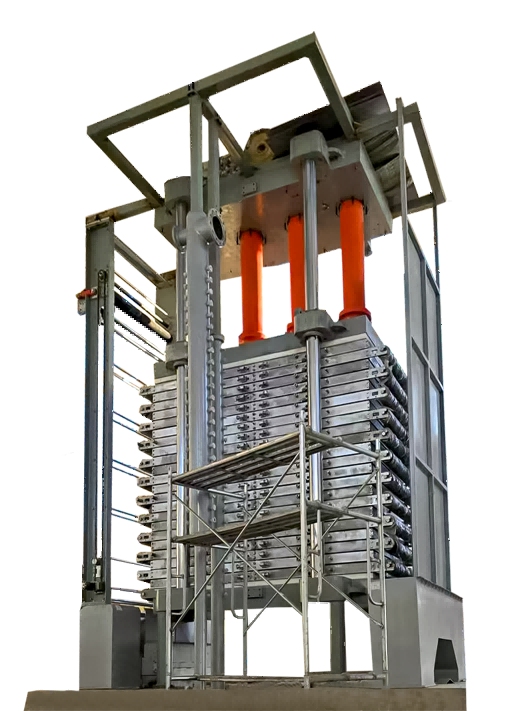
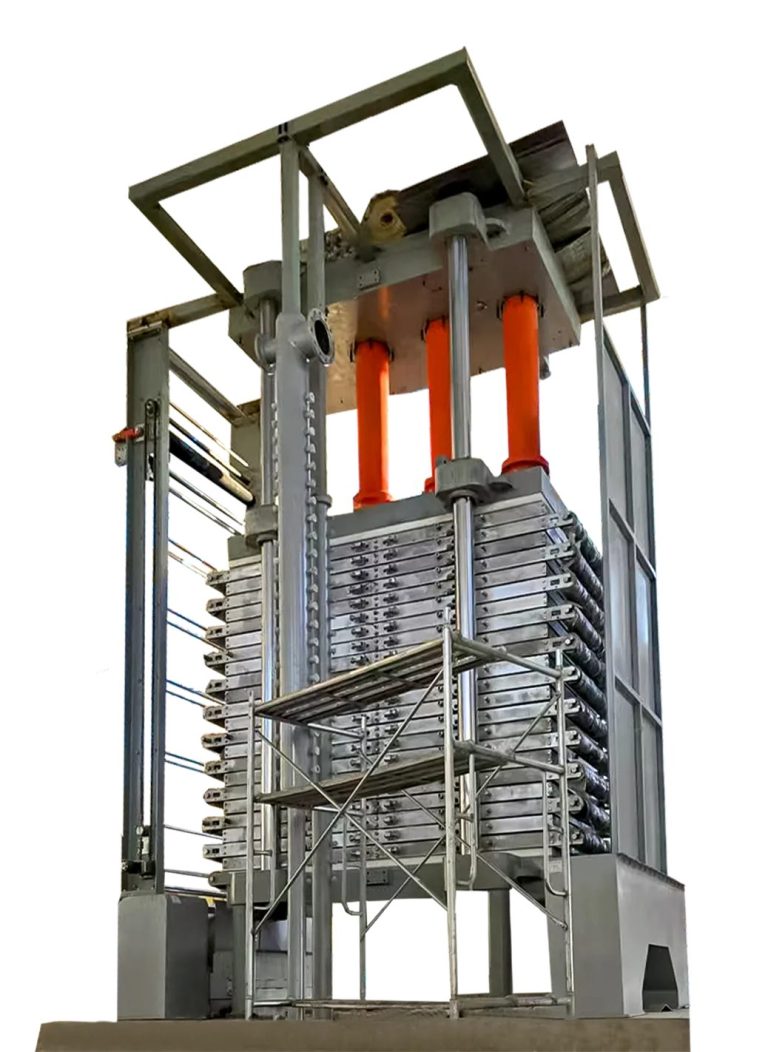
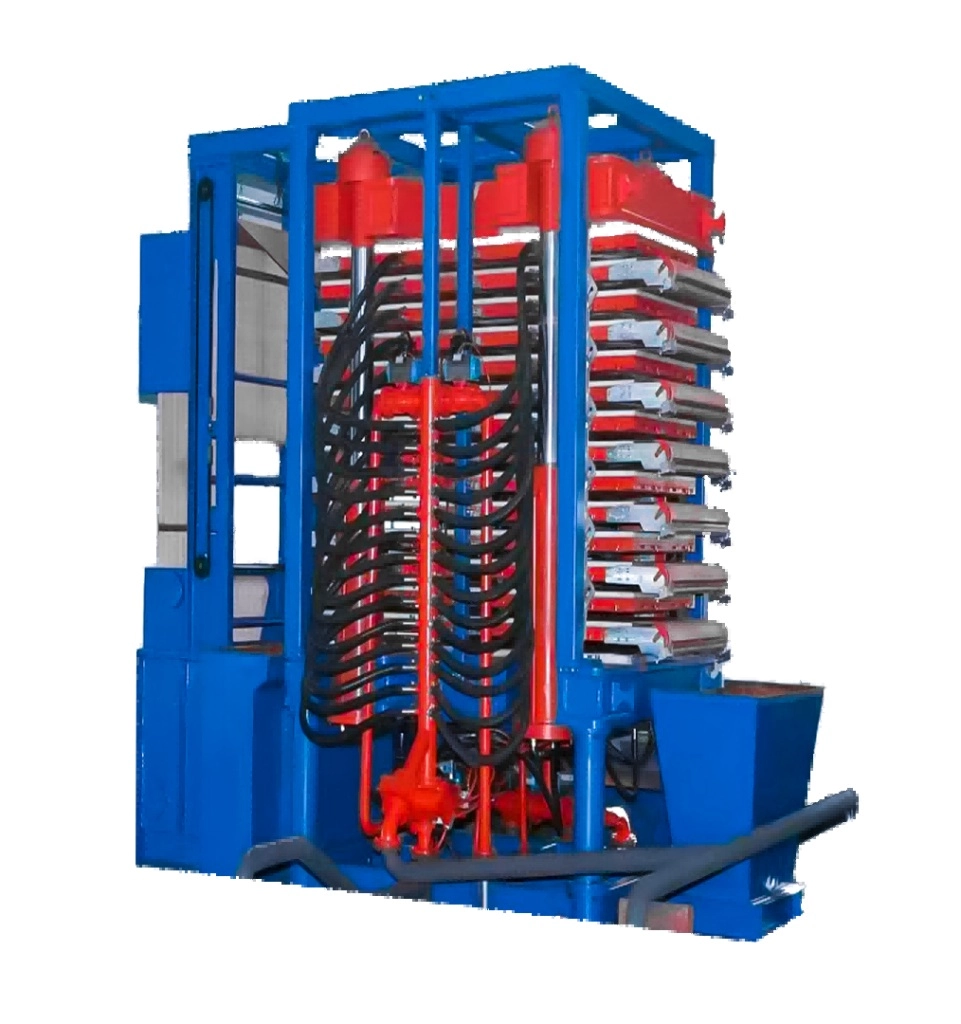
Vertical tower presses from Yantai Hexin Environmental Protection Equipment Co.,Ltd run these steps automatically. Feed, press, squeeze, blow, discharge—all sequenced with little operator input, which keeps moisture steady across shifts.
Warm slurry helps when the process allows it. Running at 40 to 60 degrees lowers viscosity and lets water escape more easily, especially on sticky chemical sludges. Stay within cloth and seal limits to avoid trouble.
Washing the cake with clean filtrate during the cycle can flush solubles and drop bound moisture further on certain products.
Put those elements together and moisture in the 15 to 25 percent range becomes routine, even on fines that used to fight every effort.
Key Factors Influencing Filter Cake Moisture Reduction
Particle size dictates how hard the job will be from the outset. Anything below 10 microns packs tight and holds water stubbornly. Coarse feeds dewater almost effortlessly; fines demand every ounce of pressure and time available.
Chemistry changes the game. Adjust pH and add the right flocculant and particles clump into larger, open flocs that release water quickly under pressure. Organic sludges respond especially well to good conditioning—moisture can drop 5 to 10 points with the proper polymer dose.
The way pressure ramps up matters. Slow buildup lets the cake compress evenly. Sudden spikes channel through weak spots and leave wet streaks.
Thicker cakes hold more total water, but the core can stay damp if the squeeze doesn’t reach all the way through. Thinner cakes dry more uniformly but limit throughput. Most operations settle between 30 and 40 mm for the best balance.
Warm slurry flows better through narrow pores. Even modest heating makes a noticeable difference on cold feeds.
Cloths degrade gradually. Blinding creeps in and moisture starts climbing before anyone spots it. Regular wash cycles keep performance consistent.
Humidity in the discharge area can let sensitive cakes pick up moisture again. Dry air curtains help in open plants.
These variables interact constantly. Change one and the others shift. That’s why pilot testing on real slurry always beats guessing.
Membrane vs Standard High-Pressure Plates: Performance Comparison
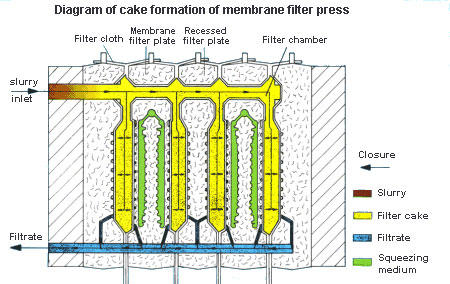
Membrane plates add a powerful step—the diaphragm squeeze after the cake forms. Standard fixed-chamber presses rely only on feed pressure, so dewatering stops once pump pressure falls.
The membrane phase applies direct mechanical force across the entire cake face, independent of slurry flow. That second push routinely cuts moisture another 10 to 15 percent on hard-to-dry materials.
Cycles lengthen with the added squeeze, but plants often make it up with higher solids per square meter of cloth. Drier cakes mean fewer truckloads leaving the site.
Energy use rises a bit for the diaphragm pump, but savings on transport and disposal usually outweigh it.
Cake releases cleaner after membrane squeezing. Less sticking means less manual cleanup and longer cloth life.
Standard plates still fit when target moisture sits above 30 percent or the feed dewaters easily in one stage. Membrane setups earn their place when dryness specs get strict.
Vertical tower designs pull ideas from both approaches—high-pressure stages paired with efficient discharge—to deliver low moisture in a small footprint.
Step-by-Step Optimization for Existing Installations
Turning around high moisture on a running press begins with solid data. Pull cake samples across several cycles and oven-dry them to pin down the baseline and see how much it varies.
Look at conditioning next. Adjust polymer dose and mixing time. Too little leaves flocs small; too much makes the cake sticky.
Extend squeeze time in five-minute jumps. Track moisture drop to find where the curve levels off.
Add or lengthen the air blow if it’s short or missing. Start at six bar for ten minutes and tweak from there.
Clean the cloths thoroughly. High-pressure rinse between batches or scheduled acid washes restore permeability fast.
Smooth out feed rate. Steady pump speed avoids channeling that leaves wet pockets.
Watch filtrate clarity. Cloudy return usually signals cloth trouble or poor cake formation.
Log every change and the resulting moisture numbers. Patterns emerge quickly once the data builds.
Small adjustments like these often shave 4 to 8 points off moisture without major capital spending.
B2B Guide: Specifying Low Moisture Requirements in Procurement
Clear specifications begin with a firm moisture target—maximum 20 percent by weight, for example—and spell out the test method, typically oven drying at 105 degrees. Minimum squeeze pressure, generally 20 bar or higher for membrane plates, along with minimum hold time, belongs in the document too. Performance guarantees backed by pilot runs on actual slurry provide real assurance. Cloth rating and material must match the chemistry, and cycle time caps protect throughput while meeting dryness goals.
The lineup at Hexin Vertical Tower Presses includes models built for tough dewatering jobs. Company background sits in the О нас section, and broader equipment selection guidance appears in How to Choose Solid-Liquid Separation Equipment. Explore the full range at Hexin Homepage.
Industry Applications and Case Studies
Tailings dry stacking in mining depends on low moisture cakes for stable piles and water recovery. High-pressure membrane pressing on flotation tails routinely hits 18 to 22 percent moisture.
Chemical plants precipitating salts push below 15 percent to cut shipping weight and improve purity.
Municipal plants combine digestion with high-pressure dewatering to get sludge down to 20-25 percent for incineration or land application.
Metal concentrates need low moisture feed for smelters. Pressing to 12-18 percent saves energy in downstream drying.
Fertilizer operations recover acid while turning gypsum into a dry, saleable byproduct.
Food byproducts like spent grains come out dry enough for economical transport after combined pressing and blowing.
These examples show how the same basic approach adapts to very different feeds.
Advanced Considerations in Moisture Control
Several additional strategies can push moisture levels even lower, especially on challenging feeds that resist standard pressing. Thickening the slurry before it reaches the press boosts feed solids concentration and reduces the overall size of press needed for a given throughput. High-rate thickeners often recover their cost surprisingly fast in large-scale operations simply through the savings on equipment footprint and power.
Vacuum assistance during the initial fill stage helps tremendously with ultra-fine particles. Drawing a mild vacuum on the filtrate side accelerates early dewatering, building a more permeable cake that responds better to later high-pressure squeezing.
Enhancing Cake Quality with Wash Cycles
Intermediate wash cycles prove valuable when soluble contaminants or residual chemicals need removal. Introducing clean filtrate or water between filtration and squeezing flushes out dissolved solids without sacrificing the low final moisture achieved by the press. This approach maintains dryness while improving product purity in chemical and food-related applications.
Automation and Real-Time Monitoring
Real-time sensors connected to programmable logic controllers bring consistency to the process. Moisture probes, pressure transducers, and flow meters feed data back to the control system, allowing automatic adjustment of squeeze time, air blow duration, or even feed rate to keep dryness within tight targets shift after shift.
Preventing Performance Drift
Scheduled cloth replacement programs prevent the slow moisture creep that comes from gradual blinding. Tracking cycle counts or filtrate clarity triggers proactive change-outs before operators notice any upward trend in cake wetness.
Energy Recovery Opportunities
Heat recovery from warm filtrate loops contributes to overall plant efficiency on bigger installations. Capturing and reusing that energy for slurry pre-heating or building services offsets some of the power needed for high-pressure pumping.
Taken together, these refinements extend the capabilities of high-pressure filter presses well beyond basic operation, delivering drier cakes on even the most difficult materials while controlling operating costs.
Introduction to Yantai Hexin Environmental Protection Equipment Co.,Ltd
Yantai Hexin Environmental Protection Equipment Co.,Ltd got its start in 1995 in Yantai City, Shandong Province, China. Over nearly three decades the company has focused on solid-liquid separation, building a line of equipment that includes vertical tower filter presses, belt filters, ceramic disk filters, and thickeners. Applications span mining, chemicals, metallurgy, and environmental protection. Hexin handles everything from single units to full turnkey projects, with particular strength in tailings treatment and resource recovery systems.
Вывод
Getting consistently low moisture filter cakes with high-pressure filter presses comes down to combining the right equipment features with careful process control. Pressure stages, conditioning, timing, and cloth maintenance all play their part. When those pieces line up, plants see real gains in handling costs, water recovery, and regulatory compliance.
Вопросы и ответы
How do I achieve low moisture filter cakes with high-pressure filter presses on fine tailings?
Raise membrane squeeze to 25 bar, hold longer, and add a good air blow cycle. Proper flocculant conditioning helps open up the structure.
What pressure works best for low moisture cakes in chemical sludge?
Secondary squeeze at 20-30 bar usually gets below 20 percent. Pre-thickening the feed makes the biggest difference.
Why is my filter cake moisture staying high with high-pressure pressing?
Look at short squeeze times, blinded cloth, or weak conditioning first. Check the pressure curve for even compression.
How can I reduce filter cake moisture further in mining dewatering?
Combine high-pressure membrane squeezing with air purging and aim for feed solids over 60 percent from thickening.
What affects low moisture results most in high-pressure filter presses?
Particle size and slurry chemistry lead the list. Fine particles and poor flocculation fight every bit of pressure you apply.