 Russian
  English
  Spanish
 Mining operations worldwide face mounting pressures from управление хвостохранилищами, where vast volumes of slurry pose risks to environments and structures alike. Traditional wet storage in dams has led to catastrophic failures, as seen in incidents where unstable impoundments gave way, releasing floods of contaminated material. Engineers and managers in the sector now turn to advanced dewatering technologies to shift toward dry stacking, a method that demands reliable solid-liquid separation. Vertical press filter working principle in mining tailings treatment offers a compelling path forward, integrating high-pressure mechanics with tailored process flows to handle the unique properties of tailings. This approach not only extracts water efficiently but also produces stackable cakes that meet stringent safety and regulatory standards. By examining how these filters interact with tailings characteristics like particle size distribution, specific gravity, viscosity, and filterability, professionals can better grasp their role in sustainable mining. Real-world applications demonstrate reductions in water usage and storage footprints, turning potential liabilities into manageable assets. The discussion ahead breaks down the mechanics and flows, providing insights for those evaluating upgrades in tailing systems.
Mining Tailings Characteristics Analysis: Why Vertical Press Filter Is an Ideal Choice
Tailings from mining vary widely depending on the ore type, but common traits make dewatering a challenge. Fine particles dominate in many cases, especially from gold or copper extractions, where grinding processes yield slurries with median sizes under 20 micrometers. Such distributions clog conventional filters easily, as tiny solids bridge pores and resist liquid passage. Vertical press filters counter this through staged compression, where initial low-pressure filling gives way to intense squeezing that forces water out despite the fines. In a typical iron ore tailing, where 40 percent of particles fall below 10 micrometers, the filter’s vertical chambers allow gravity to aid settling before full press, improving throughput without excessive blinding of cloths.
Specific gravity plays a pivotal role too. Mineral solids often range from 2.8 to 3.5, heavier than water, which promotes natural sedimentation but can lead to uneven cake formation in horizontal systems. The tower design of vertical press filters uses this density difference to advantage, channeling heavier fractions downward for uniform packing. Picture a lead-zinc tailing with a specific gravity around 3.2; as slurry enters the top, solids drop steadily, reducing the energy needed for pumping and minimizing voids in the final cake. This inherent alignment with physics cuts cycle times, often to under 20 minutes per batch, compared to longer durations in less adapted equipment.
Viscosity adds another layer of complexity. Tailings with clay content spike in thickness, sometimes reaching levels that cause cracking in dewatered cakes during drying. High viscosity slows filtration rates and risks incomplete separation, but vertical press filters mitigate through adjustable pressure ramps and diaphragm actions that knead the mass evenly. For instance, in bauxite tailings where viscosity fluctuates with pH and additives, the filter’s logic applies gradual force—starting at 5 bar and climbing to 16—allowing trapped liquids to escape without fracturing the structure. Industry experience shows that pre-treating with flocculants drops viscosity by 30 percent, paving the way for cakes with moisture below 15 percent.
Filterability ties all these together, a measure of how readily solids yield to dewatering. Poor filterability stems from slimy components that form impermeable layers, but the vertical setup excels by combining mechanical pressure with optional washing steps. Tests on phosphate tailings, notorious for low filterability due to organic residues, reveal that integrating air blows after pressing boosts dryness by expelling residual films. Decision-makers assessing options should sample their tailings for Buchner funnel tests, which predict performance; if specific cake resistance exceeds 10^12 m/kg, vertical press filters often prove superior, offering solutions where others falter.
To act on this, mining teams can start with lab-scale trials. Collect slurry samples, measure particle curves via laser diffraction, weigh densities, test viscosities with rheometers, and run filtration indexes. These steps inform whether a vertical press filter fits, potentially averting costly mismatches. Prevention comes through regular characterization, as ore bodies change over time, ensuring the system adapts without surprises.
Typical Process Flow: Thickener + Vertical Press Filter for Efficient Dry Discharge
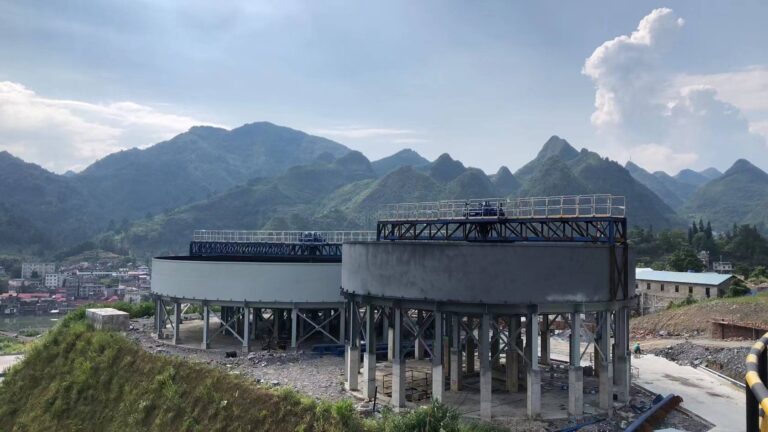
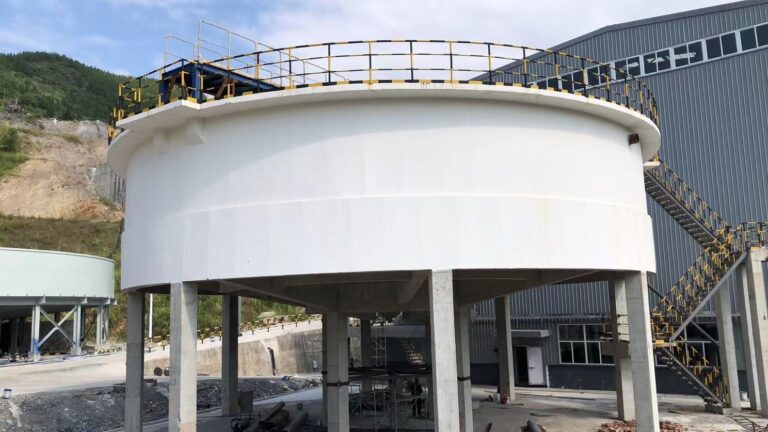
Combining thickeners with vertical press filters forms a robust chain for tailings handling, starting with volume reduction and ending in dry, stable outputs. The thickener acts as the front line, concentrating dilute slurries from flotation or leaching circuits.
First Stage – Thickener Pre-Concentration: Reducing Feed Viscosity and Volume
Thickeners settle solids through gravity and flocculants, boosting concentrations from 10-20 percent to 50-60 percent. This cuts the load on downstream filters, easing pressure on pumps and extending cloth life. In a gold mine setting, where tailings arrive at low densities, adding polymers like polyacrylamide creates flocs that sink rapidly, yielding clear overflow for recycle. The underflow, now thicker, flows to the filter with reduced water content, slashing energy demands by half in some operations. High-rate thickeners with rakes prevent bridging, handling fluxes up to 0.5 tons per square meter per hour.
Second Stage – Vertical Press Filter Feed and Chamber Filling
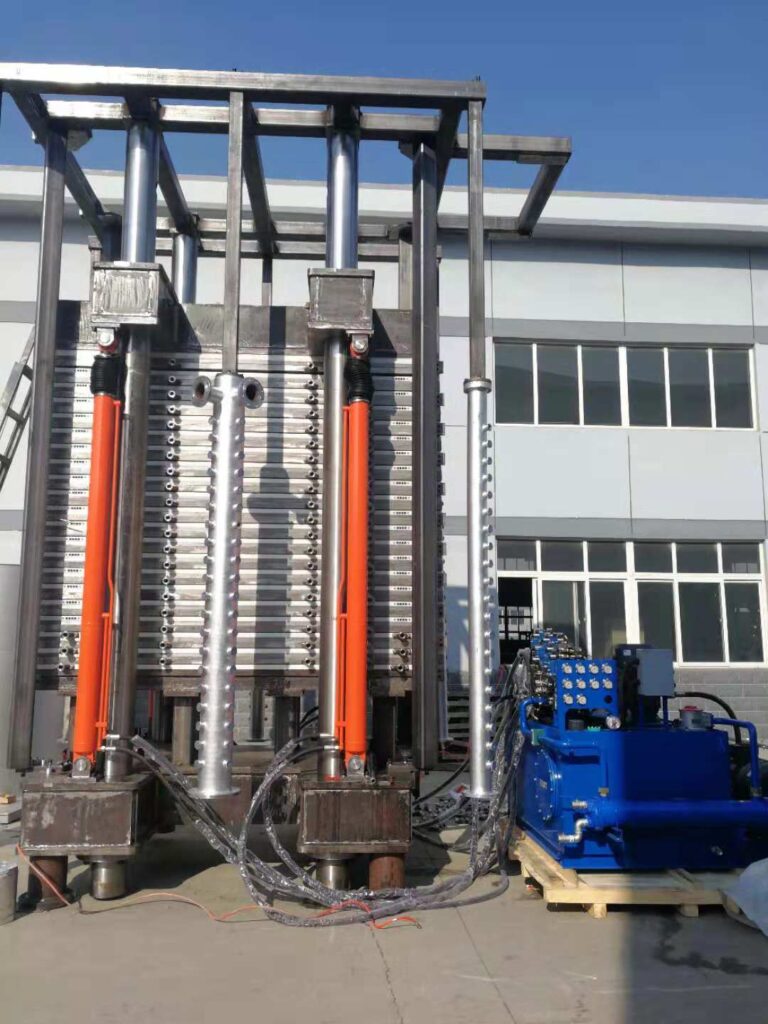
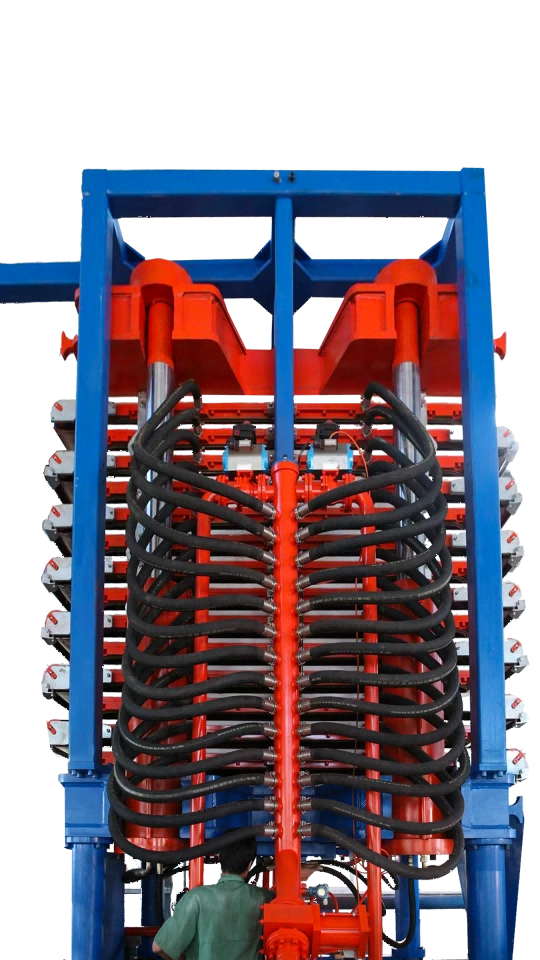
Pumped underflow enters the vertical press filter from above, filling stacked chambers lined with filter cloths. Gravity assists the descent, ensuring even distribution without the channeling seen in lateral feeds. For copper tailings with variable flows, sensors monitor inlet pressure, adjusting valves to maintain 2-3 bar during fill. This phase lasts 2-5 minutes, depending on volume, and sets the foundation for separation by allowing initial drainage through bottom ports.
Third Stage – High-Pressure Filtration and Diaphragm Pressing
With chambers full, hydraulic systems ramp pressure to 16-20 bar, forcing liquids through cloths while solids compact. Diaphragms inflate behind plates, squeezing uniformly to tackle tough tailings. In nickel operations, where fines resist flow, this dual action achieves filtration rates of 100-200 kg solids per square meter per hour. The principle hinges on building resistance gradually; abrupt jumps crack cakes, but controlled escalation expels water efficiently, often recovering 85 percent for reuse.
Fourth Stage – Blowing Dry and Cake Discharge
Compressed air then sweeps through, displacing lingering moisture to drop content below 15 percent. This step, timed at 3-5 minutes, uses 2 bar blasts monitored by humidity sensors. Dry cakes discharge automatically via bottom openings, falling onto conveyors for stacking. In coal tailings, this yields piles with shear strengths over 50 kPa, safe against liquefaction.
Fifth Stage – Filter Cloth Regeneration and Cycle Restart
High-pressure washes regenerate cloths, removing buildup with water jets and occasional chemicals. Conductivity probes confirm cleanliness before the next fill, preventing carryover that could foul batches. Cycles repeat seamlessly, with automation linking stages for 24/7 runs.
For implementation, sketch a flow diagram: thickener overflow to pond, underflow to filter, filtrate back to process, cakes to stack. Calculate capacities using formulas like throughput = filtration area × specific rate × cycles per day. If moisture targets miss, add conditioners upstream— a preventive tweak that boosts compliance.
Dual Compliance Assurance: Environmental Discharge and Storage Safety Achieved Simultaneously
Vertical press filters in tailings flows deliver on both eco-standards and structural integrity, addressing regs that demand minimal emissions and robust containment.
Environmental Discharge Perspective
By reclaiming over 80 percent of water, these systems cut discharges that could leach contaminants into groundwater. Filtrate from pressing returns clean enough for mill reuse, as in a silver mine where pH-neutralized outputs met EPA limits. This closes loops, conserving resources amid shortages, with some sites saving 200,000 cubic meters annually. To prevent issues, monitor turbidity in real-time, adjusting floc doses if spikes occur.
Storage Safety Perspective
Dry stacking forms cones with angles above 35 degrees, far stabler than wet ponds. Cakes from vertical filters compact densely, resisting erosion and seismic shifts. Post-failure analyses show dry methods reduce risks by 90 percent, extending site life by tripling capacity per area. Judge viability by cone penetration tests; if penetration exceeds norms, refine pressing for denser outputs.
Real-World Cases and Implementation Recommendations
In an iron ore project, integrating thickeners and vertical press filters handled 1,000 tons daily, achieving 82 percent solids in cakes and full water recycle. Downtime fell 25 percent through predictive maintenance on diaphragms. Another in gold tailings saw viscosity challenges resolved by pH tweaks, yielding stable stacks that passed audits.
Start with sampling and pilots: test 100-liter batches for filterability, scale to site trials. Select based on area—say, 200 square meters for mid-scale ops. Train teams on PLC interfaces, schedule cloth changes every 1,000 cycles. For decisions, weigh CAPEX against OPEX savings; ROIs often hit 18 months in water-scarce zones.
About Yantai Hexin Environmental Protection Equipment Co., Ltd.
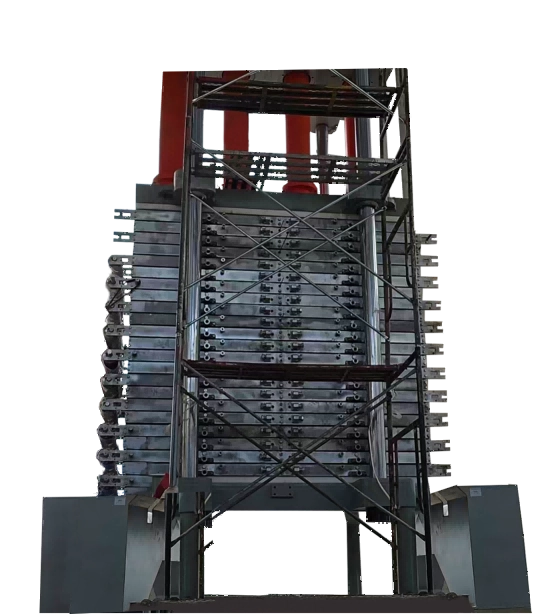
Янтай Хексин Экологическая защита оборудования Ко., ООО, situated in YEDA, Yantai City, Shandong Province, China, has pioneered filtration solutions since 1995, when it began research and manufacture of solid-liquid separation gear. Over two decades, milestones include launching rubber belt vacuum filters in 2002, ceramic vacuum filters in 2007, and vertical filter presses in 2010. By 2012, the company boasted over 100 field applications and more than 1,000 customers, leading to its 2017 restructuring. Specializing in belt filters, ceramic filters, tower filter presses like the TFP model, high-efficiency thickeners, and EPC projects, Hexin serves mining, metallurgy, and tailing treatment with automated, low-energy systems. Its professional R&D, production, and after-sales teams uphold quality, fostering global ties in environmental protection.
Вывод
Вертикальные пресс-фильтры, through their principled design and integrated flows, transform mining tailings from hazards to resources, meeting dual demands for safety and sustainability.
Вопросы и ответы
How does vertical press filter working principle handle fine particle tailings in mining?
Vertical press filters use gravity-fed filling and high-pressure diaphragm squeezing to compact fine particles under 20 micrometers, overcoming clogging by staged compression that expels water efficiently, as proven in gold tailings where 80 percent solids content is routinely achieved.
What is the thickener and vertical filter press process for tailings dry stacking?
The process starts with thickeners concentrating slurry to 50-60 percent solids, then feeds into vertical press filters for pressing, drying, and discharging dry cakes suitable for stacking, ensuring water recovery over 80 percent and stable piles in copper mining operations.
Can vertical press filter dewatering manage high viscosity mining tailings?
Yes, by applying gradual pressure ramps up to 20 bar and incorporating flocculants to lower viscosity, vertical press filters prevent cake cracking in clay-rich tailings, delivering moisture levels below 15 percent in bauxite applications.
What moisture content does vertical filter press achieve in tailings treatment?
Vertical filter presses typically reduce moisture to 10-15 percent in tailings cakes through filtration, pressing, and air blowing stages, supporting dry stacking that meets environmental regs in iron ore sites.
How does vertical press filter help mining meet environmental compliance for tailings?
By enabling high water recycling rates above 80 percent and producing non-liquefiable dry stacks, vertical press filters minimize discharges and dam risks, aligning with global standards in silver mining for safer, greener operations.