 Russian
  English
  Spanish
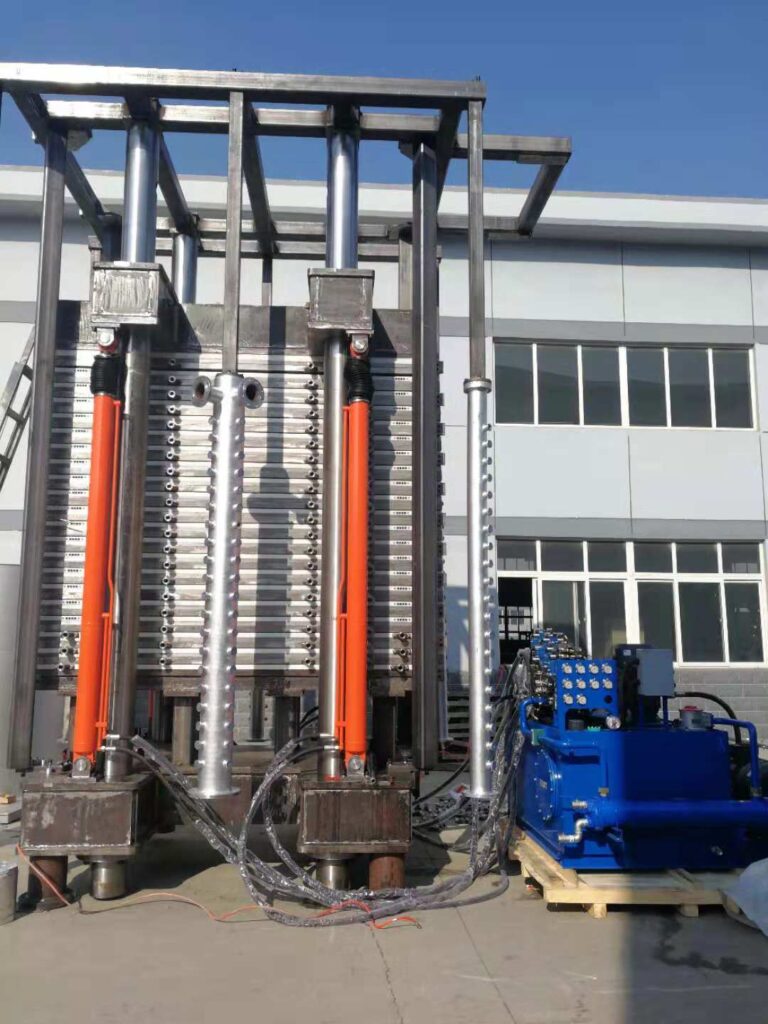
 Вертикальные пресс-фильтры represent one of the most effective technologies for high-efficiency solid-liquid separation in modern industry. Widely applied in mineral processing, metallurgical tailings, chemical production, municipal sludge dewatering, and wastewater treatment, these machines achieve cake moisture levels that belt filters and centrifuges can only approach at far higher energy cost. The superior performance arises from the controlled interplay of three fundamental phenomena: pressure differential across the filter medium, dynamic flow behavior during the cycle, and progressive structural evolution of the filter cake. This article examines each mechanism in detail, drawing on established filtration theory and extensive industrial practice.
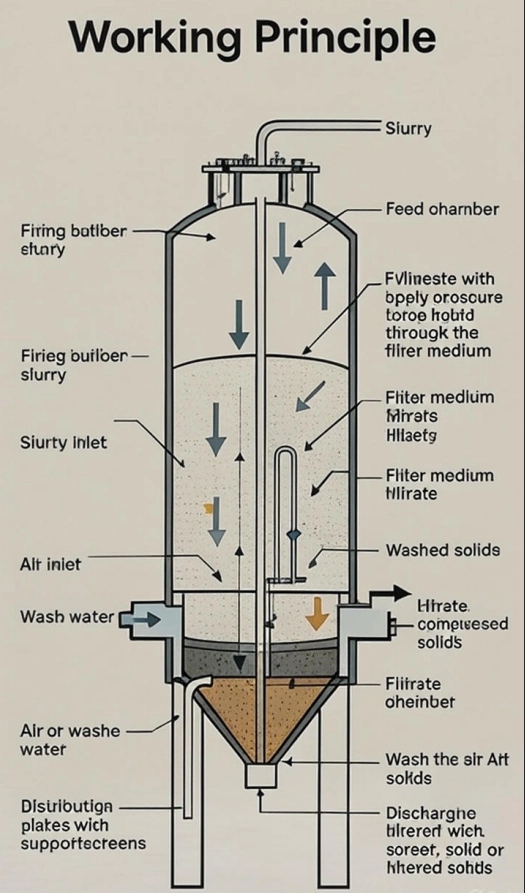
The Role of Pressure Differential in Filtration
Pressure differential remains the primary driving force in all pressure filtration processes. In vertical press filters, it is systematically developed and maintained throughout multiple stages of the operating cycle.
Physical Origin of Pressure Differential
The total pressure difference acting across the filter cloth comprises three distinct components:
- feed pressure delivered by the slurry pump (typically 6–12 bar in the filling stage)
- hydrostatic pressure generated by the slurry column within the chamber (0.3–1.8 bar depending on chamber height)
- membrane squeeze pressure supplied by compressed air or water (elevating total pressure to 15–25 bar in the expression phase)
This staged pressure build-up distinguishes vertical press filters from conventional plate-and-frame units and is responsible for their ability to handle difficult, compressible suspensions.
Mathematical Description: Darcy’s Law in Cake Filtration
The instantaneous filtrate flow rate through an established cake is accurately described by the integrated form of Darcy’s law:
Q = (ΔP · A) / (μ · (α · w · A + Rm))
where Q = volumetric flow rate ΔP = applied pressure differential A = total filtration area μ = filtrate viscosity α = specific cake resistance w = mass of dry cake per unit volume of filtrate Rm = medium resistance
As filtration proceeds, both cake thickness and average specific resistance increase, causing the familiar exponential decline in flow rate that characterizes constant-pressure filtration.
Pressure Regimes in Modern Vertical Press Filters
Contemporary vertical press filters routinely operate at 16–20 bar during the membrane squeeze phase, with certain heavy-duty designs reaching 25 bar for extremely fine or highly compressible materials. Experimental data from copper concentrate and coal tailings demonstrate that cake moisture decreases approximately linearly with the logarithm of applied pressure up to ≈16 bar; beyond this threshold, marginal dryness gains diminish rapidly while mechanical stress on diaphragms and filter plates rises sharply.
Flow Dynamics and Process Control
Flow behavior in vertical press filters is inherently transient, requiring precise orchestration to maximize throughput and cake quality.
Characteristic Flow Profile of a Complete Cycle
A typical filtration cycle exhibits three distinct phases:
- High initial flow during chamber filling and initial cake deposition (200–600 L/min·m²)
- Rapid decline as cake resistance dominates (flow drops by 80–90 % within 5–10 minutes)
- Prolonged low-rate expression and air blow (final moisture removal occurs at <30 L/min·m²)
Modern control systems exploit this predictable profile by switching automatically from constant-flow to constant-pressure to falling-rate operation.
Influence of Feed Slurry Characteristics
Filtrate viscosity, particle size distribution, and solids concentration exert profound effects on achievable flow rates. Suspensions containing >15 wt% clay-sized particles (<2 μm) routinely reduce specific flux by an order of magnitude compared with coarse crystalline slurries. Temperature also plays a critical role: a 20 °C increase in slurry temperature can reduce viscosity sufficiently to improve flux by 30–50 % in high-solids applications.
Advanced Flow Optimization Strategies
State-of-the-art vertical press filters incorporate several features to maintain optimal flow:
- variable-speed feed pumps with pressure-feedback control
- automated core blow and cloth cleaning
- staged membrane inflation sequences
- integrated cake washing and air purging subsystems
These enhancements routinely reduce total cycle time by 25–35 % while improving cake uniformity across all plates.
Pore Structure Evolution and Filter Cake Consolidation
The progressive compression of the filter cake constitutes the central mechanism governing final moisture content and filtration rate.
Initial Cake Formation and Bridging
During the first 30–120 seconds, particles form a permeable bridge across the cloth openings. Porosity typically exceeds 65 %, and specific resistance remains close to that of a non-compressible sediment.
Intermediate Compression and Pore Closure
As pressure rises, interparticle voids collapse and fine particles migrate into larger pores, dramatically increasing specific cake resistance (α values commonly rise from 10⁹–10¹⁰ m/kg in the initial layer to 10¹¹–10¹³ m/kg near the cloth). This phenomenon, termed “cake blinding,” dominates cycle economics in fine-particle systems.
Final Expression and Consolidation
Membrane squeeze and extended air blow phases achieve the majority of moisture reduction by collapsing remaining macropores and expelling capillary-bound water. Terzaghi–Voigt consolidation theory provides the most accurate mathematical description of this viscoelastic deformation under sustained pressure.
Influence of Filter Medium Selection
Cloth permeability, weave pattern, and surface finish directly determine final pore structure. Multifilament calendered cloths routinely produce 2–4 % lower cake moisture than equivalent monofilament fabrics on compressible tailings, albeit with slightly longer discharge times.

Introducing Yantai Hexin Environmental Protection Equipment Co., Ltd.
Янтай Хексин Экологическая защита оборудования Ко., ООО specializes in the design and manufacture of advanced vertical press filters for demanding solid-liquid separation applications. With nearly two decades of focused development, the company has established itself as a leading supplier to the global mining, metallurgical, and environmental protection sectors.
Hexin’s current generation of vertical press filters incorporates oversized hydraulic systems, reinforced diaphragm technology, and sophisticated PLC control algorithms optimized through extensive field data. These machines consistently deliver cake moisture below 10 wt% on copper concentrates, below 15 wt% on coal tailings, and cycle times 20–30 % shorter than earlier designs, while maintaining diaphragm life beyond 3,000 cycles under normal operating conditions.
Вывод
The exceptional performance of вертикальные пресс-фильтры results from the precise engineering of pressure differential, transient flow management, and controlled cake consolidation. Mastery of these interrelated phenomena enables achievement of dryness levels and throughput rates unattainable by alternative technologies. Continued advances in materials science, automation, and process control ensure that vertical press filtration will remain the benchmark for high-performance solid-liquid separation in the decades ahead.
Вопросы и ответы
What pressure range do modern vertical press filters typically operate at?
Most units operate between 16–20 bar during membrane squeeze, with specialized models reaching 25 bar for extremely fine materials.
How does temperature affect filtration performance?
A 20 °C increase in slurry temperature commonly improves flux by 30–50 % through reduced viscosity.
Why does filtration rate decline so rapidly after initial filling?
Rapid decline results from exponential growth in cake resistance as fines migrate and pores collapse.
What is the primary benefit of membrane squeeze technology?
Membrane squeeze achieves significantly lower cake moisture (often 3–8 % reduction) compared with simple pressure filtration alone.
How does Yantai Hexin achieve extended diaphragm life?
Through optimized pressure ramp profiles, reinforced rubber compounds, and precise plate alignment that minimize localized stress concentrations.