 Spanish
  English
  Russian
 For a lot of plants, the filtro de prensa vertical is that tall, enclosed machine at the end of the line that “just makes dry cake.” Operators know the cycle time and a few setpoints, but when moisture creeps up or throughput drops, the root cause is often unclear. At that point, knowing how a vertical press filter works is no longer an academic question; it becomes the difference between stable production and a bottleneck that never quite goes away.
This article walks through the vertical press filter working principle in a structured way, from slurry feed through cake formation, washing, squeezing, drying and discharge. The focus is on the tower-type vertical press filter used for high-pressure solid–liquid separation, with enough technical detail that process engineers can connect what they see on the HMI to what actually happens inside each chamber.
Why understanding the working principle pays off
Moving from “black box” to engineered unit operation
In many concentrators, hydrometallurgical plants and chemical facilities, filtration is treated as an end-of-pipe utility. Upstream teams tune grinding, leaching or crystallization, and the filter is expected to keep up. When cake moisture rises two or three points or cycle times stretch, the first reaction is often to increase feed pressure or extend squeezing time without a clear hypothesis.
Once you understand the vertical press filter operation step by step, those adjustments become targeted. If filtrate flow tails off too early, you can ask whether cloth permeability, feed concentration or chamber filling is limiting. If washing is poor, you can look at wash distribution and diaphragm movement, not just throw more wash water at the problem. In other words, the working principle becomes a diagnostic tool.
Positioning the vertical press filter among other technologies
A vertical press filter occupies the same general space as belt filters, ceramic filters or conventional plate-and-frame presses, but its internal mechanics are different. In the tower configuration, a stack of horizontal filter plates forms multiple superposed chambers inside a vertical frame. Slurry is filtered in closed chambers under high pressure; cakes are then squeezed, washed and air-dried in place before automatic discharge. Operating filtration pressures up to 20 MPa allow this equipment to handle fine, sticky slurries and still produce low-moisture cake.
For tailings, leach residues, electrolytic sludges or difficult chemical streams, that combination of pressure, squeezing and automation is often more attractive than vacuum filtration or low-pressure presses.
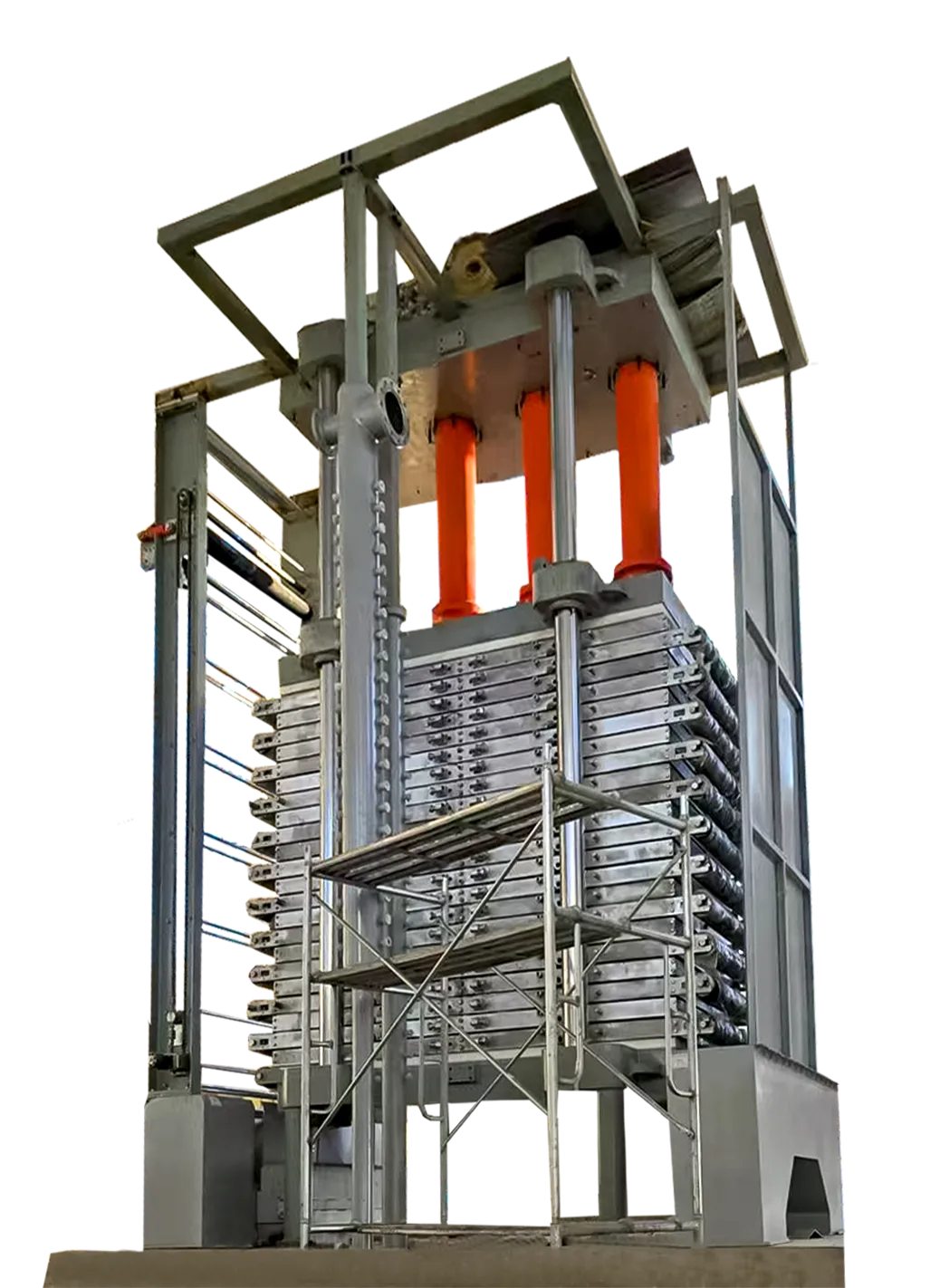
Internal structure of a vertical press filter
Tower frame and filter chambers
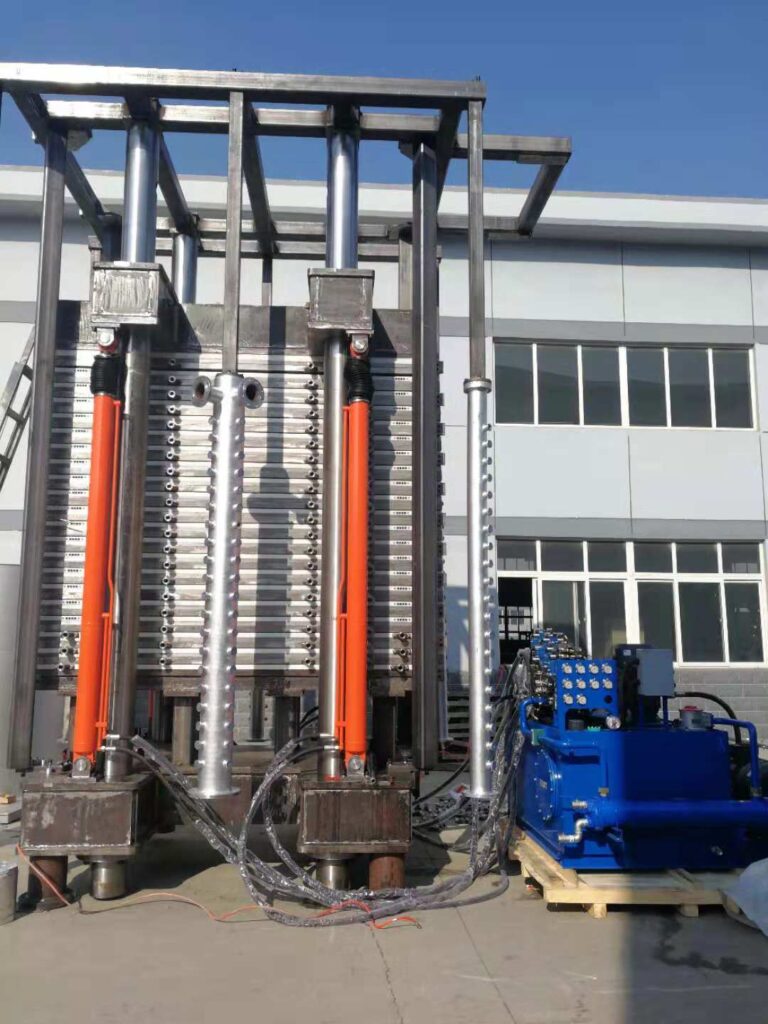
At the core of the vertical press filter structure and working principle is the plate stack. Multiple filter plates are arranged in a tower and, when the frame closes, form sealed horizontal chambers. Each plate is lined with filter cloth on both sides, so every gap between plates is a self-contained filtration space. Slurry enters the chambers via feed ports; filtrate passes through cloth and drainage channels into a common manifold and out through flexible discharge hoses.
This architecture lets the machine handle a large filtration area in a relatively small footprint while keeping the process enclosed, which is important for dirty, corrosive or toxic slurries.
Diaphragm system and hydraulic clamping
Above the plate pack sits a flexible diaphragm connected to a high-pressure water circuit. When press water enters this circuit, the diaphragm deforms and applies uniform pressure to the cakes inside each chamber. Large hydraulic cylinders clamp the frame, moving the plate stack between open and closed positions and maintaining sealing force during filtration and squeezing.
In tower-type designs, multiple cylinders run synchronously on a self-guided system to maintain alignment of the filter pack and prevent binding under high loads. That structural detail is central to the vertical press filter working principle, because squeezing at 1–2 MPa or more on the cake side is only possible if the frame can absorb and transmit the corresponding reaction forces.
Cloth movement and cake discharge mechanism
The filter cloth runs as a continuous loop through the plate stack. After each cycle, the cloth drive moves it, and mechanically assisted discharge devices help cakes separate from the cloth surfaces and fall into hoppers or conveyors on both sides of the tower. At the same time, residual solids are removed from the cloth so that the filtration surface is regenerated for the next cycle. This cloth handling is not an accessory; it is a built-in part of the vertical press filter process from slurry to dry cake and a major factor in cycle stability.
Vertical press filter operation step by step
Slurry feed and primary filtration
The cycle begins with the plate stack fully closed and clamped. Slurry is pumped into the closed filter chambers. As soon as feed enters, a pressure gradient develops between the feed side and the filtrate side of the cloth. Liquid passes through the cloth and support structure into the filtrate channels, while solids are retained and accumulate as a growing cake layer on the cloth. Filtrate leaves through soft hoses and is collected in the filtrate header.
Initially, most of the resistance is in the cloth and drainage paths. As the cake builds, it becomes the dominant resistance and the primary filtering medium. At a given feed pressure, the vertical press filter working principle naturally transitions from high flow and thin cake to low flow and thick cake as the run progresses.
First squeezing stage
Once the chambers are filled and the filtrate flow decays to a defined limit, the system stops feed and initiates the first squeezing stage. High-pressure water is admitted to the diaphragm circuit. The diaphragm pushes against the cakes, compacting the porous structure, closing inter-particle voids and expelling interstitial liquid back through the cloth into the filtrate channels.
Because squeezing is applied uniformly across each chamber, the cake experiences more homogeneous compression than in many conventional presses. This is one of the reasons the vertical press filter working principle delivers lower residual moisture at comparable or shorter cycle times.
Cake washing
If the process requires low soluble carryover—for example, in hydrometallurgical residues or product filtration—a washing phase is inserted after initial squeezing. Wash liquor is introduced through the same distribution system as the slurry until the chambers are filled. The diaphragm is then actuated to force wash liquid through the cake toward the filtrate channels, displacing mother liquor.
This “fill and press” approach means the wash liquid sees the full cake cross-section instead of just channeling through preferred paths, which can significantly improve washing efficiency per unit volume compared with simple gravity or flow-through washing. It is a key part of the vertical press filter working principle in applications where leach recovery or product purity is critical.
Secondary squeeze and gas drying
After washing, the machine can perform a second squeeze with high-pressure water to reduce residual wash liquor. The final dewatering stage uses gas, typically compressed air. Gas is admitted to the diaphragm chamber; as the diaphragm moves again, gas pushes through the cake and drives out remaining liquid film and free water from the filtrate side.
This gas-driven drying step is what turns a mechanically dewatered cake into a free-draining, free-falling solid with low residual moisture. It also clears the filtrate channels and hoses of liquid, which shortens the time required for the next feed step and reduces cross-contamination between filtrate batches.
Cake discharge and cloth regeneration
When drying is complete, hydraulic pressure on the plate stack is released and the frame opens. The cloth drive runs; cakes detach from both sides of the plate stack and drop into the discharge system under gravity and mechanical assistance. As the cloth moves, any remaining fines are removed, restoring permeability. At the end of this vertical press filter operation step by step, all chambers are empty, the cloth is clean and the machine is ready to close again and start a new cycle.
In modern designs, the full sequence—feeding, filtering, squeezing, washing, gas drying, opening, discharging and cloth washing—is controlled by a PLC and instrumented with pressure, position and flow feedback, so the vertical press filter can operate as a largely automatic unit with minimal manual intervention.
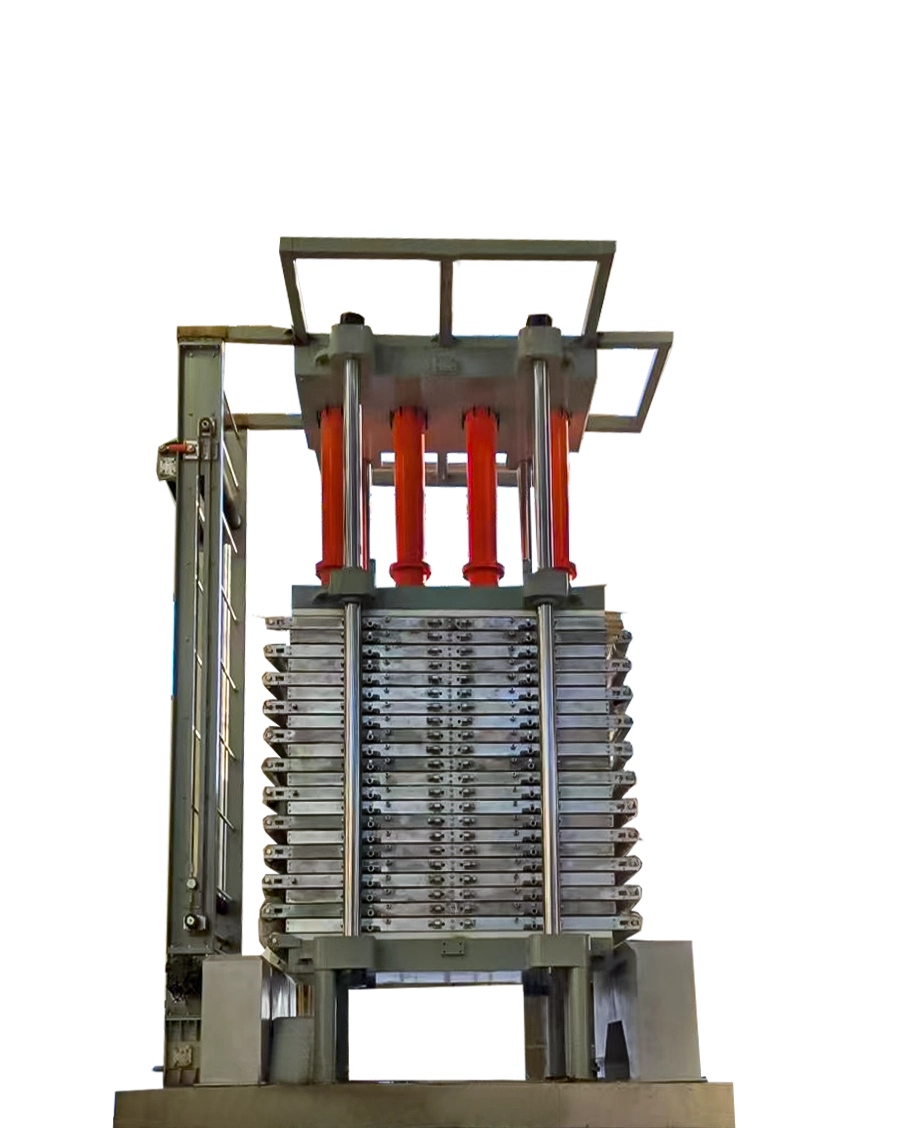
Performance outcomes of the working principle
The combination of high filtration pressure, diaphragm squeezing and gas drying gives the tower-type vertical press filter a distinct performance envelope. Typical duties include mineral tailings, oxide concentrates, electrolytic residues, leaching residues, slag dewatering, sewage sludge and waste acid operations where fine particle size and poor settling make vacuum or low-pressure equipment ineffective.
In these services, plants report low cake moisture, clear filtrate, reduced thermal drying requirements and easier cake handling. The closed, automatic cycle can also reduce operator exposure and housekeeping in comparison with open trough equipment, which is important in corrosive or toxic circuits. The filtro de prensa vertical process from slurry to dry cake is thus not just a mechanical sequence but a way to achieve environmental compliance and cost reduction in one unit operation.
Yantai Hexin Ambient Protection Equipment Co., Ltd
Yantai Hexin Ambient Protection Equipment Co., Ltd is located in Yantai Economic and Technological Development Zone in Shandong Province and specializes in the manufacture, research, development and sale of filtration equipment. The company has more than twenty years of experience in the filter industry and operates with dedicated R&D and sales service teams, in-house processing and quality control, and a complete after-sales service system.
Its main products include belt filters, ceramic filters, vertical press filters, high-efficiency thickeners and EPC tailings projects, which are applied in chemical, mining, metallurgy, fertilizer, medicine, food, paper, sewage treatment and tailings treatment fields. Within this portfolio, the tower-type vertical press filter is a flagship solution for high-pressure solid–liquid separation, particularly in tailings dewatering and hazardous waste reduction.
Operating under the principle of “survive by quality and develop by credibility,” the company combines equipment supply with process support, commissioning and long-term service, which is exactly what many industrial buyers expect when they adopt a machine as central to their flowsheet as a vertical press filter.
Conclusión
Seen from the outside, a tower-type unit is just a vertical frame that closes, waits and then drops cakes. Once you know the vertical press filter working principle, the same cycle looks very different. You can trace the slurry as it fills each chamber, picture the cake building on the cloth, understand how diaphragm movement and gas flow compress and dry the cake, and see why cloth cleaning and hydraulics are as important as pump capacity.
For engineers responsible for dewatering fine or difficult slurries, that understanding is not optional. It is what lets you design meaningful pilot tests, interpret pressure and flow trends, and decide whether a vertical press filter is the right choice compared with other solid–liquid separation technologies. For plant owners, it provides a technical basis for investing in high-pressure equipment that can reduce tailings pond load, cut thermal drying costs and improve overall environmental performance.
From slurry feed to dry cake, the vertical press filter is a tightly choreographed sequence of mechanical and hydraulic actions. When that sequence is understood and applied correctly, the machine becomes a predictable, high-value part of the process rather than an opaque “last step” that is blamed whenever something upstream changes.
Preguntas frecuentes
What is the core vertical press filter working principle in simple terms?
A vertical press filter pumps slurry into closed filter chambers, forms a cake on the cloth, then uses high-pressure water and compressed gas acting on a diaphragm to squeeze and dry that cake before automatically discharging it and cleaning the cloth.
How does a vertical press filter process from slurry to dry cake differ from a conventional plate-and-frame press?
In a tower machine, many horizontal chambers are stacked in one vertical frame and operated as a single automatic unit. Diaphragm squeezing and gas drying are integrated into the cycle, so the vertical press filter process from slurry to dry cake reaches lower residual moisture with less manual handling than most traditional presses.
Where does the driving pressure come from in a vertical press filter working principle?
The driving force starts with the feed pump during the filtration phase, then shifts to high-pressure water acting on the diaphragm during squeezing, and finishes with compressed gas during the drying stage, all acting across the cake and cloth to move liquid out of the chambers.
What types of slurries are best suited to a vertical press filter?
Fine-grained, sticky or otherwise hard-to-dewater slurries such as mineral tailings, leach residues, metal oxide concentrates, electrolytic sludges and some industrial or municipal sludges benefit most from the high pressures and staged squeezing built into a vertical press filter working principle.
Is the vertical press filter operation step by step fully automatic?
On modern units, the vertical press filter operation step by step—closing, feeding, filtering, squeezing, washing, gas drying, opening, cake discharge and cloth regeneration—is executed automatically by a PLC and hydraulic and valve control system, with operators mainly supervising, adjusting recipes and responding to alarms rather than manually sequencing each phase.